One day there was an anonymous present sitting on my doorstep—Volume One of Capital by Karl Marx, in a brown paper bag. A joke? Serious? And who had sent it? I never found out. Late that night, naked in bed, I leafed through it. The beginning was impenetrable, I couldn’t understand it, but when I came to the part about the lives of the workers—the coal miners, the child laborers—I could feel myself suddenly breathing more slowly. How angry he was. Page after page. Then I turned back to an earlier section, and I came to a phrase that I’d heard before, a strange, upsetting, sort of ugly phrase: this was the section on “commodity fetishism,” “the fetishism of commodities.” I wanted to understand that weird-sounding phrase, but I could tell that, to understand it, your whole life would probably have to change. His explanation was very elusive. He used the example that people say, “Twenty yards of linen are worth two pounds.” People say that about every thing that it has a certain value. This is worth that. This coat, this sweater, this cup of coffee: each thing worth some quantity of money, or some number of other things—one coat, worth three sweaters, or so much money—as if that coat, suddenly appearing on the earth, contained somewhere inside itself an amount of value, like an inner soul, as if the coat were a fetish, a physical object that contains a living spirit. But what really determines the value of a coat? The coat’s price comes from its history, the history of all the people involved in making it and selling it and all the particular relationships they had. And if we buy the coat, we, too, form relationships with all those people, and yet we hide those relationships from our own awareness by pretending we live in a world where coats have no history but just fall down from heaven with prices marked inside. “I like this coat,” we say, “It’s not expensive,” as if that were a fact about the coat and not the end of a story about all the people who made it and sold it, “I like the pictures in this magazine.”A naked woman leans over a fence. A man buys a magazine and stares at her picture. The destinies of these two are linked. The man has paid the woman to take off her clothes, to lean over the fence. The photograph contains its history—the moment the woman unbuttoned her shirt, how she felt, what the photographer said. The price of the magazine is a code that describes the relationships between all these people—the woman, the man, the publisher, the photographer—who commanded, who obeyed. The cup of coffee contains the history of the peasants who picked the beans, how some of them fainted in the heat of the sun, some were beaten, some were kicked.For two days I could see the fetishism of commodities everywhere around me. It was a strange feeling. Then on the third day I lost it, it was gone, I couldn’t see it anymore.

Wallace Shawn, The Fever


(To understand it, your whole life would probably have to change.)

hamlet-trash:

why are umbrellas so pleasing to watch on stage? the illusion of being outside and being under the eternal sky is created by a real object. a metaphor of limitlessness is created by the very real limit of an actual umbrella indoors. cosmology is brought low by the temporary shelter of the individual against water. the sight of an umbrella makes us want to feel both wet and dry: the presence of rain, and the dryness of shelter. the umbrella is real on stage, and the rain is a fiction. even if there are drops of water produced by the stage manager, we know that it won’t really rain on us, and therein lies the total pleasure of theater. a real thing that creates a world of illusory things.

I have an umbrella with a picture of the sky inside. my daughter anna said, when she was three and underneath it, “we have two skies, the umbrella sky and the real sky.” when I went out with her in the rain recently without an umbrella, she said, “it’s all right, mama. I will be your umbrella.” and she put her arms over my head.

sarah ruhl, “umbrellas on stage”

beachdeath:

It is the phenomenon sometimes called alienation from self. In its advanced stages, we no longer answer the telephone, because someone might want something; that we could say no without drowning in self-reproach is an idea alien to this game. Every encounter demands too much, tears the nerves, drains the will, and the spectre of something as small as an unanswered letter arouses such disproportionate guilt that one’s sanity becomes an object of speculation among one’s acquaintances. To assign unanswered letters their proper weight, to free us from the expectations of others, to give us back to ourselves—there lies the great, the singular power of self-respect. Without it, one eventually discovers the final turn of the screw: one runs away to find oneself, and finds no one at home.

I Love My Biological Mother Joan Didion

maxofs2d:

darksnowfalling:

warpedellipsis:

quasi-normalcy:

meariver:

huntokar:

quasi-normalcy:

No, I’m serious, if women all got together and went into electrical engineering or automotive repair en masse, then ten years later people would be talking about how it was a “soft field” and it would pay proportionately less than other fields.

Likewise, if men moved en masse to bedeck themselves in sparkles and make-up, then suddenly you’d get a bunch of editorials talking about how classy they look.

None of these things are inherently masculine or feminine; none of these things inherently elevate you or drag you down. But whatever women are seen to do is automatically seen as being inherently more frivolous than anything men do. And shaming women for not pigeonholing themselves into a narrow range of acceptable “masculine” behaviours is just going to result in the goalposts getting moved once again.

This is literally what happened to basically every field women have entered. The opposite happens when men enter. Computers used to be a “woman thing” until the guys who did it got really mad about how badly their job was viewed and realized they could fix it by forcing out women.

Also happened/ is happening with the fields of biology and psychology….

I honestly wonder how much of the backlash against public education in the last generation has been due to teaching becoming a woman-dominated profession.

Fashion used to be a men’s thing. Then women got involved in the late 17/1800’s, so men went the other way because it came to be seen as “frivolous” and “anti-intellectual” to care about how you looked. Add in the homophobia that arose around that time, bam, staid bland dress. Ditto leggings/tights, that are now called attention-whoring when on men they were required to show you cared about your figure and had the money to pay for such a fitted item. 

People want to say misogyny doesn’t exist, that male privilege doesn’t exist. Look beyond “living memory” and you’ll find that’s what drives the “inexplicable reversals” society seems to make on many things. Hell, just look beyond your own society, and you’ll find out that what’s considered “for men” elsewhere is held in high esteem while here it’s scoffed at purely because it’s “for women”: 

  • Skinny jeans are the height of masculinity in several east Asian societies, rather than being seen as “gay” in the USA because of their association with femininity. 
  • Medical fields in Russia are valued like kindergarten teachers are here, because it’s women who are the doctors instead of men.
  • Love and romance are highly valued in eastern countries, because men are interested in it too—of course they would be, surely you want to share your life with someone? Here, it’s strictly a women’s subject.

The field of anthropology as a whole illustrates this.

Significantly higher proportions of females compared to males are currently entering the fields of archaeology and biological anthropology, and as this occurs, the prestige, funding, acceptance as valid kinds of science, etc, are fading quickly.

This has already occurred with linguistic anthropology and cultural anthropology. Cultural anthropology in particular went VERY quickly from being seen as a manly, scientific discipline (e.g., Franz Boas, Bronisław Malinowski) to being seen as a touchy-feely female thing.

Let’s examine a traditionally male-dominated role that is very well-respected, and well-paid, in many parts of the world — that of a doctor. In the UK, it is listed as one of the top ten lucrative careers, and the average annual income of a family doctor in the US is well into six figures. It also confers on you significant social status, and a common stereotype in Asian communities is of parents encouraging their children to become doctors.

One of my lecturers at university once presented us with this thought exercise: why are doctors so highly paid, and so well-respected? Our answers were predictable. Because they save lives, their skills are extremely important, and it takes years and years of education to become one. All sound, logical reasons. But these traits that doctors possess are universal. So why is it, she asked, that doctors in Russia are so lowly paid? Making less than £7,500 a year, it is one of the lowest paid professions in Russia, and poorly respected at that. Why is this?

The answer is crushingly, breathtakingly simple. In Russia, the majority of doctors are women. Here’s a quote from Carol Schmidt, a geriatric nurse practitioner who toured medical facilities in Moscow: “Their status and pay are more like our blue-collar workers, even though they require about the same amount of training as the American doctor… medical practice is stereotyped as a caring vocation ‘naturally suited‘ to women, [which puts it at] a second-class level in the Soviet psyche.”

What this illustrates perfectly is this — women are not devalued in the job market because women’s work is seen to have little value. It is the other way round. Women’s work is devalued in the job market because women are seen to have little value. This means that anything a woman does, be it childcare, teaching, or doctoring, or rocket science, will be seen to be of less value simply because it is done mainly by women. It isn’t that women choose jobs that are in lower-paid industries, it is that any industry that women dominate automatically becomes less respected and less well-paid.

http://cratesandribbons.com/2013/12/13/patriarchys-magic-trick-how-anything-perceived-as-womens-work-immediately-sheds-its-value/

thedaytoday:

residentgoodgirl:

residentgoodgirl:

I think one of my least favorite types of responses to people speaking up on sexual harassment and sexual assault is are articles like “in wake of weinstein, men wonder if hugging women still ok”, and comments like “this is why men don’t pursue women anymore”, “i don’t wanna work with women cause i don’t want a lawsuit”, or “i don’t even look at women anymore cause everything is sexual harassment”. this is a particular brand of rape culture, men acting as if women are overreacting, as if men don’t have the basic social skills to know the difference between wanted and unwanted advances, as if women simply setting boundaries is “cramping their style” and “emasculating” them, as if the rules of respecting women are super confusing, so confusing that they’re supposedly forcing men not to interact with us altogether.

this is an act they’ve been putting on for decades: playing stupid, pretending not to know better and then getting upset when we tell them what “better” is. if that doesn’t show you how emotional and emotionally manipulative they are, i don’t know what does.

So well written, I feel this entirely.

No need to answer this, but I was wondering if you’d share your process of coming to recognize that you are lesbian? I grew up in an intensely heteronormative society and defaulted to the assumption that I was straight for 21 yrs, and for a year now I’ve been trying to figure out if I’m attracted to girls, asexual, or just straight after all, but I haven’t made much progress. But hearing how others came to terms with themselves is helpful, and I’d love to hear your story, if you feel like it.

the-moon-loves-the-sea:

the-moon-loves-the-sea:

Hello, are you me? Seriously, I have been where you are. I’ll write you back later today when I have the time to answer this properly. ❤

All right, so, leaving out a few bits involving people I love who didn’t plan to have their lives written out online…

In elementary, in first grade, a boy was my best friend. I wrote in my diary that I loved him. He was nice. The next year I was friends with Megan with the round glasses, who gave herself insulin injections in the nurses’ office. She intimidated me. She was solid and smart and fascinating. All the other girls in my class had a crush on blue-eyed Matt. I thought they were silly.

At
seven, my friend kissed a boy. So I kissed a boy too. I didn’t feel anything. That year I made friends with Heidi with hazel eyes and three piercings in
her ears. She was snarky and cool. She got jealous of my other best
friend a lot. I was jealous of her other best friend, too.

At nine my mom took me out of school to homeschool me.

When I was eleven I met up with Heidi at a playground,
and she started talking about the boys playing basketball. She thought
they were cute. I was wildly disappointed in her. I never spoke to her
again. That summer the neighbor girls starting walking around in
slim-cut capris. I remember how their legs looked, long and tan and
grown-up. My neighbor Sam took me into her bedroom and
painted my nails a sparkly color.
It
was the happiest I’d been in a long time. My mom scolded me for it. I felt guilty that I didn’t
feel guilty. I started wearing fake stick-on earrings to Sam’s
house, since I wasn’t allowed real ones. I hoped she’d think I was pretty too.

At eleven my mom sat me down for the Big
Talk and mentioned seriously that some people had sex with their own
gender, and they were confused, and it was wrong. I got the impression
from her tone that their existence was sad and dangerous and almost
unmentionable. Later that year, when I was overflowing with excitement about a new friend at church, a boy, Mom said happily,
“You like him!” I was horrified. I said, “No, he’s just my friend,” but I
knew she didn’t believe that, and I sat for the rest of the car ride in
the silent certainty that she’d spoiled it. I didn’t think she was wrong; she knew about boys and crushes, and I didn’t. I just knew I’d never talk to him again. I wished I hadn’t found out I liked him. I did
like the idea that he might have a crush on me, though. He had pretty
eyes. After that I thought if boys liked me, the happiness I felt
meant I liked them back, and the fear I felt just meant I
was shy. I didn’t talk to them.

At twelve I picked up my neighbor when we were hanging out, being silly. I held her, her butt in my hands, and felt a
lot of unexpected things. I came panicking to my mom; told her I was gay. She
said no, everyone felt like that about butts. I was a little reassured. At
twelve I wore plaid button-downs and shapeless tee shirts and sneakers.
I thought I was more mature than the girls in sparkly things. They were
disturbingly pretty. I wasn’t allowed to see naked
pictures of boys in the Renaissance art books. I wondered what their
penises looked like.

I wanted to cut off my hair.

At
thirteen I read that Tchaikovsky was gay, and that it
tormented him all his life. I loved Tchaikovsky.  After that it broke my hear to hear his music. (Fifteen years later, I found out
that he was open and happy, that
his songs were dedicated to the men he loved, and that he’d been
tormented and suicidal only when he’d tried marrying a woman. I was so
angry and so, so relieved.)

(Fifteen years later, I found out Jane
Austen, who’d written the beautiful, clever women I loved in college,
was probably gay; that Louisa May Alcott, who’d written my best girl Jo
March, went by Lou and happily admitted she’d loved many women and never
a man. I found out Chopin and Handel and Walt Whitman and Hans Christian
Andersen were gay and my beloved Beauty and the Beast was
scored by a gay man who helped them adapt the Beast’s character around
his own outcast unacknowledged love.)

At fourteen I had a crush on a boy, a pen-pal I never had to actually see. An older girl did my lipstick in the back hall before we went
onstage to dance. She told me I had a perfect cupid’s bow lip as she
traced it. I thought about that for years. I stopped being scared of boys; but I got bored of them as soon as I knew
they were really interested. I did like that they liked me. It made me feel powerful and very
aware of my body. I still didn’t want to talk to them.

At fourteen my mom kept me off the internet,
and away from movies, and music, and novels about love. I kept my eyes turned away from the
checkout aisle magazines because mom said there were things I shouldn’t
see. She meant Cosmo’s sex tips but I thought she meant the beautiful
women in tiny clothes. That year
I looked at the bra models in the Target ads and something
warmed inside of me. I told my mom that I thought I was gay,
and she said everyone felt like that about the underwear models.

I was alone a lot. I read and wrote and daydreamed
about adventure and travel and war, and tried to ignore the fact that I
was endlessly, deeply, numbly anxious about everything in the precarious world for no reason I knew. I felt disconnected from the world, in it but not part
of it. I thought I’d be a spy, living on secrets, or a pilot, floating free above
the planet, or a missionary, like beautiful Amy Carmichael, who
never got married. She lived with the other missionary girls and her
books and her birds and her adopted children, free and happy, all her life. I was going to be
single forever, just like her.

At fourteen, and fifteen, and sixteen, and seventeen, I didn’t know any girls my age.

At
eighteen I went to Christian college and suddenly there were
girls everywhere. Beautiful, glorious, funny, ambitious, clever women,
and within weeks I had a crush. And then another. And another. Too
scared to look at her, I told my roommate I felt things about girls
sometimes. I figured she deserved to know. She didn’t panic. I told my
R.A. She didn’t look horrified. I told the college prayer counselor. She
kind of shrugged.

I still thought I was never
getting married, but once in a while I imagined finding a good missionary boy and not being alone for the rest of
my life. I wasn’t used to being lonely any more. But I didn’t think about girls. I knew if you weren’t going to turn out gay, you had to never think about it. I had friends. I adored them. I was shy and
fascinated, I loved their hands and voices and the way they lined their eyes, but I didn’t think about them. I cuddled with them and did their hair and watched movies on their beds, and felt disappointed in them when they talked about the men onscreen and the boys on campus, and adored Penelope
Cruz in Sahara with my whole heart, but I didn’t think about girls.

I
graduated. I traveled a lot, worked community projects across Africa. I tried to date the guys I was good friends with, the sensible ones, the kind and funny and cute ones. I felt panicky and numb and trapped. I didn’t like
holding hands, and kissing felt like nothing much. I wondered what was
wrong with me, that my anxiety wouldn’t let me love anyone. I shoved
down the panic and smiled. Everyone said I was always happy. No one knew I cried every day for no good reason, and that I did feel happy but never whole.

When I was twenty-five all my friends who’d gone through ex-gay counseling were miserable and scared and still gay, and the ex-gay counselors were giving up. I stopped believing queer people weren’t real. I started watching YouTube videos of gay proposals, and
reading coming-out stories, and researching the science around queers’ existence. I started really thinking about why I was so drawn to those stories, why I felt hungry and lonely and happy and alive in the middle of them.

When I was twenty-five I thought I was bi.

When
I was twenty-five and twenty-six and twenty-seven I let myself think
about girls. They were beautiful and they made me happy. And the more I
let myself notice it, the more I realized I felt so much more deeply and
easily for them than I did for boys, even the boys I really loved.
Women scared me, but they delighted me. I joined queer clubs, and talked about my shit. I
cut off my hair. I cried a lot and wrote a lot and read a lot of gay fic and for the first time I understood why people feel the way they do about love stories.

When I was twenty-eight I started to say I was gay.

When
I was twenty-nine I got a therapist and she said I could be a lesbian. She said I could just give in and be what I wanted to be. I
didn’t have to prove it.

When I was twenty-nine I felt more whole and free and clear-headed and calm than I had since I was eleven.

antiandrogen:

florencelovesyou:

honey–wolf:

dirtandleather:

solarcat:

stimulateyoursenses:

noheckingwaycupid:

kfedup:

positive-memes:

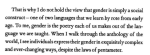
I Will Not Be Eaten

Girl. Yes.

The voices of little girls are so powerful and profound because they haven’t yet been completely eaten away at by social conditioning. 

“I am a rich pie filled with knowledge. I will not be eaten.” Holy fuck my new motto.

Transcription (with original line breaks):

The true feminine

I am not sugar and
spice and everything nice.
I am music, I am art.
I am a story. I am a
church bell, gonging out wrongs
and rights and normal nights.
I was baby. I am child. I will
be mother. I don’t mind being
considered beautiful, I do not
allow that to be my
definition. I am a rich
pie strong with knowledge. I
will not be eaten.

i’m not kidding, this poem shook me to my core. it inspired me more than any famous poet in the past few months. this little girl is going to influence the world in such a beautiful way.

little girls are gonna rule the goddamn world

my little queen

Aw she’s brilliant

butch-lesbijan:

realizing that i’m a lesbian suddenly made me feel so much more confident about my fashion sense. i can wear a beanie and a shirt and weird trousers and sunglasses and not feel bad about it. i can wear mismatched clothes with a jacket that’s too big and not style my hair and not feel ashamed because men think i’m not attractive. i don’t care. i’m a lesbian and fuck you.